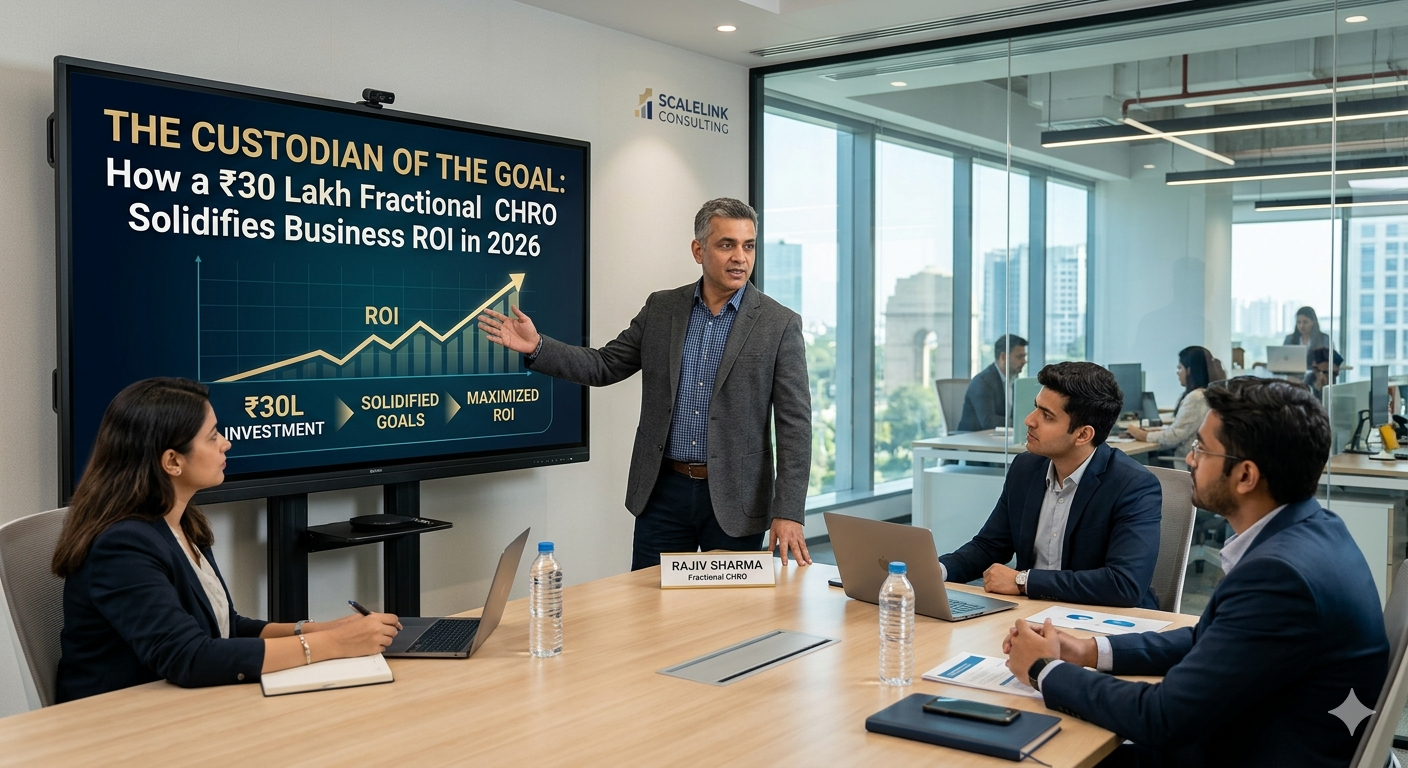
The Custodian of the Goal: How a ₹30 Lakh Fractional CHRO Solidifies Business ROI in 2026

Authored by
Flipcarbon
Date Released
26 June, 2026
Categories
Blog
The New Industrial Revolution in India
As we cross the mid-point of 2026, the Indian business landscape is no longer defined solely by its massive corporations. The real story is being written by the over 63 million MSMEs that contribute nearly 30% to the nation’s GDP. However, these businesses are facing a crisis that capital alone cannot solve: the crisis of human complexity.
In a world where AI-driven productivity is the baseline, the "Human" in Human Resources has become the most expensive and volatile variable. Founders are realizing that they can no longer treat HR as an administrative afterthought. Yet, the price of world-class leadership is staggering. This has led to the rise of the Fractional CHRO a model that offers the strategic "soul" of a senior leader at a price point that makes sense for a growing balance sheet.
In 2026, the Indian MSME sector is facing a paradox. Technology is faster than ever, capital is more precise, yet many founders feel their growth is "stuck." The reason is rarely the product or the market; it is the Strategic Alignment Gap. Many founders mistake HR for an administrative function, a department meant to handle the "plumbing" of the office. But a true Chief Human Resources Officer (CHRO) is not a plumber; they are the Custodian of Organizational Goals. When you bring in a Fractional CHRO at a ₹30 lakh price point, you aren't paying for "HR support." You are paying for a guardian who ensures that every heartbeat in your office is synchronized with your year-end EBITDA targets.
Part I: The CHRO as the Architect of "The Goal"
In most growing businesses, the founder has a vision in their head, but by the time that vision reaches the junior executive, it has been diluted by 60% to 70%. This "Alignment Leak" is what kills profitability.
Beyond CVs and Payroll
It is vital to distinguish what a high-level Fractional CHRO does not do. They do not spend their days sourcing CVs or running payroll software. Those are operational tasks that can be automated or delegated. In fact, a strategic leader knows that their time is too valuable to be spent in the weeds of administrative processing.
A Strategic CHRO focuses on:
- Organizational Design: Is your structure built for 2024 or 2027?
- Performance Engineering: Moving from "showing up" to "impact delivered."
- Succession and Leadership: Ensuring the business doesn't collapse if a key person leaves.
- Culture as a KPI: Building a "High-Trust, High-Pressure" environment where top talent thrives.
The CHRO’s primary duty is to ensure that the organization’s structure, talent, and culture are all pulling in one direction: The Founder’s North Star.
Part II: The 10% Productivity Rule – The Math of ROI
Founders often ask, "Can I afford a ₹30 lakh retainer?" The better question is: "Can I afford a 10% drop in productivity?"
In 2026, the math of the Fractional CHRO is simple but devastatingly effective. Let’s look at a typical Indian MSME with 100 employees and an average annual revenue of ₹50 Crore.
The Productivity Lever
If your total employee cost (the "People Bill") is ₹10 Crore, a Fractional CHRO doesn't need to perform miracles. They only need to enhance the collective productivity of the team by 10%.
- The Current State: 100 people working at 65-70% efficiency due to poor goal clarity, management bottlenecks, or lack of structured feedback.
- The CHRO State: Through high-level intervention clarifying KRAs, removing internal friction, and aligning incentives the CHRO boosts efficiency to 80%.
The Result: That 10% lift in output translates to an additional ₹5 Crore in revenue capacity without adding a single new head to the payroll.
The ROI Calculation: You invested ₹30 Lakh to unlock ₹5 Crore in value. Your "Sorted ROI" is over 16x. This makes the retainer feel less like a cost and more like a high-yield investment.
Part III: The "Custodian" Mindset – Why it Saves 40% on HR Costs
While the headline promise of saving 40% on HR costs is compelling, it is important to understand that these savings don't come from cutting salaries. They come from eliminating systemic waste.
1. Eliminating "Zombie" Roles
Without a senior strategist, companies often hire "reactionary" roles. “We’re busy, let’s hire three more people.” A Custodian CHRO asks: “Why is the current team busy? Is it a process failure or a talent gap?” By optimizing the existing structure, they often prevent unnecessary hires, saving the company ₹40–60 lakh in annual fixed CTC.
2. The High-Performance "Filter"
A Fractional CHRO ensures that "Underperformance" is not an option. By implementing rigorous (yet fair) performance systems, they ensure the company isn't carrying "dead weight." Replacing the bottom 10% of underperformers with "A-Players" doesn't just save money; it creates an exponential leap in departmental output.
3. Culture as a Risk Mitigation Tool
In 2026, a toxic culture is a financial liability. Glassdoor reviews, internal friction, and "quiet quitting" are silent killers of MSMEs. The CHRO acts as the Cultural Custodian, ensuring the founder's values are lived at every level. This reduces the "Drama Tax" the time and money spent on internal conflicts and grievance management.
Part IV: A 12-Month "Goal-First" Roadmap
How does a ₹30 Lakh Fractional CHRO spend their time if they aren't doing recruitment or payroll? They spend it on the Engine of the Business.
Quarter 1: The Alignment Audit
- Goal Mapping: Checking if all employees know the Top 3 goals of the company.
- Leadership Assessment: Identifying which managers are "Force Multipliers" and which are "Friction Points."
- System Audit: Reviewing if current performance metrics actually drive revenue.
Quarter 2: Infrastructure for Scale
- KRA/KPI Architecting: Designing a performance dashboard that links employee work directly to company revenue.
- Incentive Design: Building bonus structures that actually motivate people to hit the Founder’s targets, not just their own.
Quarter 3: Capability Building
- High-Potential Programs: Identifying future leaders so the founder can finally step away from day-to-day operations.
- Productivity Tools: Implementing the right tech stack (AI, Project Management) to automate the "low-value" work.
Quarter 4: Cultural Solidification
- The Performance Review 2.0: A radical shift from "critique" to "growth planning."
- Scaling the Vision: Preparing the people-side of the business for the next 2x growth spurt.
Part V: The Psychological ROI – The Founder’s Peace of Mind
We talk a lot about numbers, but the most significant saving is the Founder’s Cognitive Load. The average MSME founder in India spends roughly 30% of their week dealing with people issues mediating conflicts, worrying about someone leaving, or trying to explain the vision for the tenth time.
When a Custodian CHRO takes over, that 30% of the founder's time is "bought back." If a founder’s time is valued at ₹10,000 per hour, regaining 12 hours a week results in an ₹80 lakh indirect return. This allows the founder to return to their "Zone of Genius" innovation and growth.
Mentorship of the "Internal Soul"
A Fractional CHRO doesn't replace your junior HR team; they elevate them. In most MSMEs, the HR team consists of young "Generalists" who are overwhelmed. The Fractional CHRO acts as a mentor-in-residence. They provide the roadmap, and the internal team executes it. This builds a leadership pipeline from within.
Part VI: Why Fractional? Why Now?
The reason the ₹30 lakh model works in 2026 is that it offers Seniority without the Sunk Cost. A full-time CHRO at ₹80 lakh+ might become "part of the furniture." They get embroiled in office politics and lose their objective edge.
A Fractional CHRO maintains an outsider’s clarity with an insider’s passion. They are there for one reason: To hit the Goal.
The 2026 Tipping Point
- Profitability over Growth: Investors now demand "Unit Economics." A Fractional CHRO is a signal that the company is serious about lean, high-impact operations.
- The Talent War: You don't win talent by out-spending MNCs; you win by out-organizing them.
- Digital Transformation: Senior leaders can now manage strategy in 10-15 hours a week because AI handles the data crunching.
Investing in the Soul of the Business
If you are an MSME founder in 2026, you are likely sitting on a goldmine of untapped potential within your current team. You don't need more CVs; you need more Direction. You don't need better payroll; you need better Performance Engineering.
At ₹30 Lakh, a Fractional CHRO is not an expense it is an insurance policy for your dream. It is the strategy that allows you to scale with heart, lead with data, and grow with confidence.
As we look at the remainder of 2026 and beyond, the companies that thrive will not be those with the biggest HR departments, but those with the smartest HR strategies. Stop viewing HR as an expense to be minimized. Start viewing it as a Custodial Service for your Dreams. With the right CHRO in place, your organizational goals aren't just "targets" on a wall they become the inevitable outcome of a perfectly aligned machine. The question is no longer whether you can afford a Fractional CHRO, but rather: Can you afford to let your organizational goals go unguarded?